
AI Agent Architecture: 6 Protocols You Need to Know

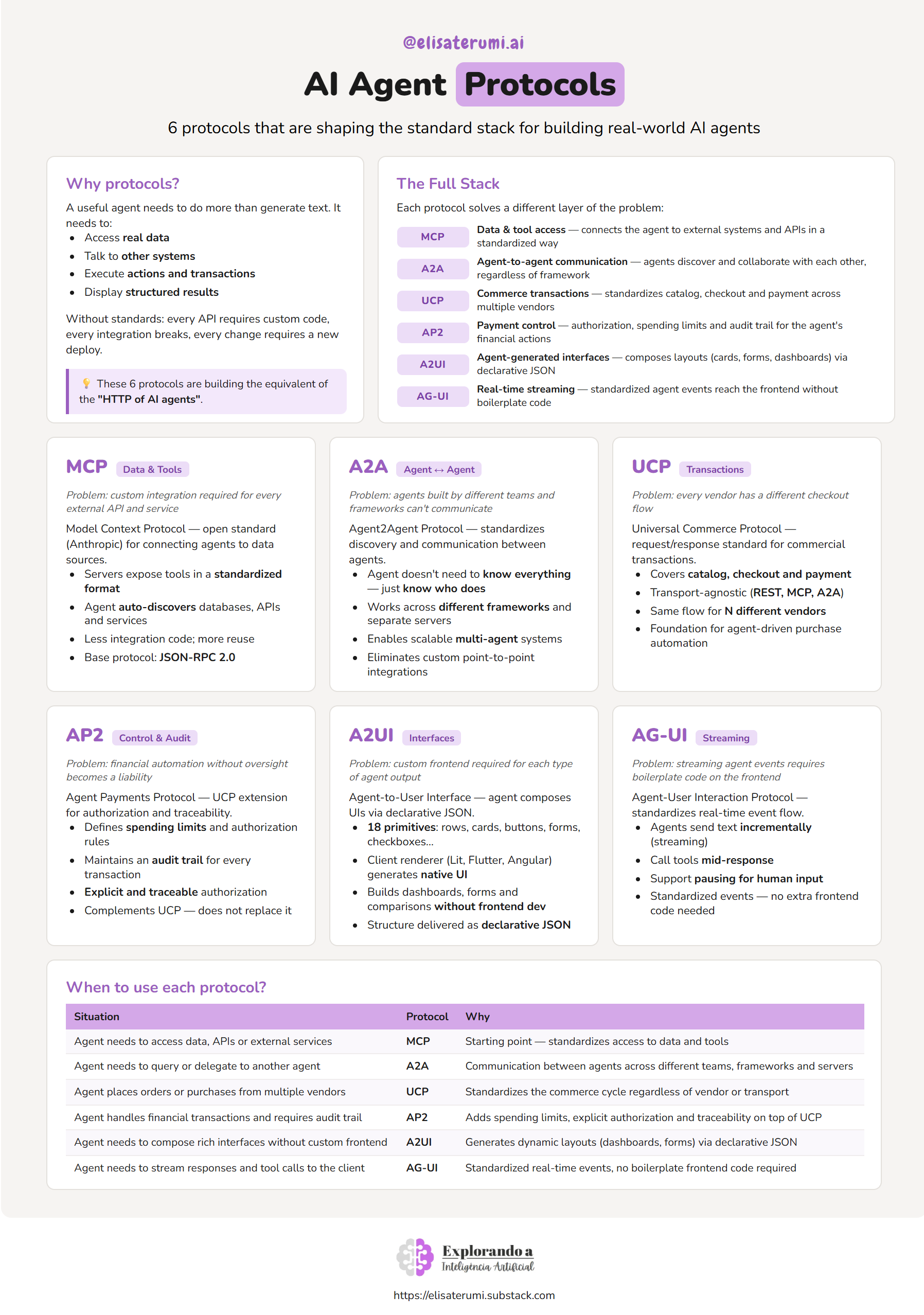
AI agents are becoming more powerful. But also more complex.
If you’ve ever tried to build a “real” agent (connected to data, APIs, other agents, and interfaces), you’ve probably noticed the problem:
It’s not the model.
It’s the integration.
Today, the ecosystem is full of acronyms: MCP, A2A, UCP, AP2, A2UI, AG-UI.
It may seem confusing. But it’s not random. These protocols are quietly forming the standard stack for AI agents.
Each one solves a different problem. None replaces the others. And understanding this completely changes how you build systems.
Follow our page on LinkedIn for more content like this! 😉
See also:
The problem no one talks about
A useful agent needs to do more than generate text.
It needs to:
access real data
talk to other systems
execute actions
perform transactions
present results in a structured way
Without standards, this turns into chaos:
→ every API requires custom code, every integration breaks, every change requires a new deployment.
That’s exactly what these protocols solve.
The agent stack (explained simply)
1. MCP: Model Context Protocol
The problem it solves: connecting your agent to external systems and data.
Without MCP, you write custom integration code for every API, endpoint, and service. With MCP, servers expose their tools in a standardized format, and your agent discovers them automatically.
Instead of writing integrations manually, the agent can automatically discover:
databases
APIs
external services
Less code. More standardization.
👉 MCP solves the first bottleneck: access to data and tools.
2. A2A: Agent-to-Agent Protocol
The problem it solves: enabling agents to discover and communicate with each other.
When the knowledge you need lives in another agent—possibly built by another team, in another framework, on a different server—you would normally need custom integration for each one. A2A standardizes this.
Your agent doesn’t need to know everything. It just needs to know who does.
👉 A2A: agents talking to agents.
3. UCP: Universal Commerce Protocol
The problem it solves: standardizing the purchasing cycle across multiple vendors.
If your agent needs to place orders with five different suppliers, you’re dealing with five different checkout flows. UCP defines a standard request/response format for catalog, checkout, and payment—independent of transport (REST, MCP, A2A).
It doesn’t matter if there are five different suppliers—the flow is the same.
👉 UCP standardizes purchases and orders.
4. AP2: Agent Payments Protocol
The problem it solves: authorization and auditing of payments made by agents.
UCP defines what your agent bought and from whom. AP2 defines who approved it and keeps the audit trail.
It includes:
spending limits
rules
explicit authorization
traceability
Without this, automation becomes risk.
AP2 plugs into UCP as an extension—it doesn’t replace it, it complements it.
👉 AP2 adds control.
5. A2UI: Agent-to-User Interface Protocol
The problem it solves: eliminating the need for custom frontends for each type of agent output.
A2UI allows the agent to compose layouts dynamically using 18 component primitives (rows, columns, cards, text fields, buttons, checkboxes, etc.).
The structure comes as declarative JSON; a client-side renderer (Lit, Flutter, Angular) turns it into a native UI.
This means the agent itself can build interfaces:
dashboards
forms
comparisons
Without manual frontend development.
👉 A2UI: interfaces generated by the agent.
6. AG-UI: Agent-User Interaction Protocol
The problem it solves: streaming agent events to the frontend without building a custom base structure.
Agents don’t behave like traditional REST APIs.
They stream text gradually, call tools mid-response, and sometimes pause for human input. Interpreting this flow in the frontend requires repetitive code—and can break when event formats change.
In short:
How does the agent communicate with the user?
Answer: via standardized, real-time events.
👉 AG-UI: real-time streaming and interaction.
When to use each one
Most agents start with MCP for data access. The rest comes in as needs grow:
Need your agent to query another agent? → A2A
Need to handle transactions with multiple vendors? → UCP
Need control and audit over spending? → AP2
Need rich UIs without maintaining custom frontend? → A2UI
Need to stream tool calls and text in real time? → AG-UI
Each protocol solves a specific problem. Understanding these boundaries keeps your architecture clean.
🚀 What changes in practice
When you combine all of this, something interesting happens.
The agent stops being a chatbot.
And becomes a complete system, capable of:
querying real data
making decisions
executing actions
performing payments
generating interfaces
explaining everything in real time
The most important insight
You don’t need to use everything. In fact, you shouldn’t.
Most systems start with:
👉 MCP (data)
And evolve as needed:
👉 A2A (collaboration)
👉 UCP + AP2 (transactions)
👉 A2UI + AG-UI (experience)
That’s the new path.
Recommended Books:
TL;DR
These protocols are becoming the equivalent of:
→ “the HTTP of AI agents.”
And those who understand this early will build systems that are much faster—and far more scalable.
If you’re building with LLMs, this is worth watching closely.
Because the future of agents isn’t just in the model.
It’s in the architecture.