
The New Era of Software Development: From Vibe Coding to Agentic Engineering
With 41% of all new code now generated by AI, the way we build software has fundamentally changed.

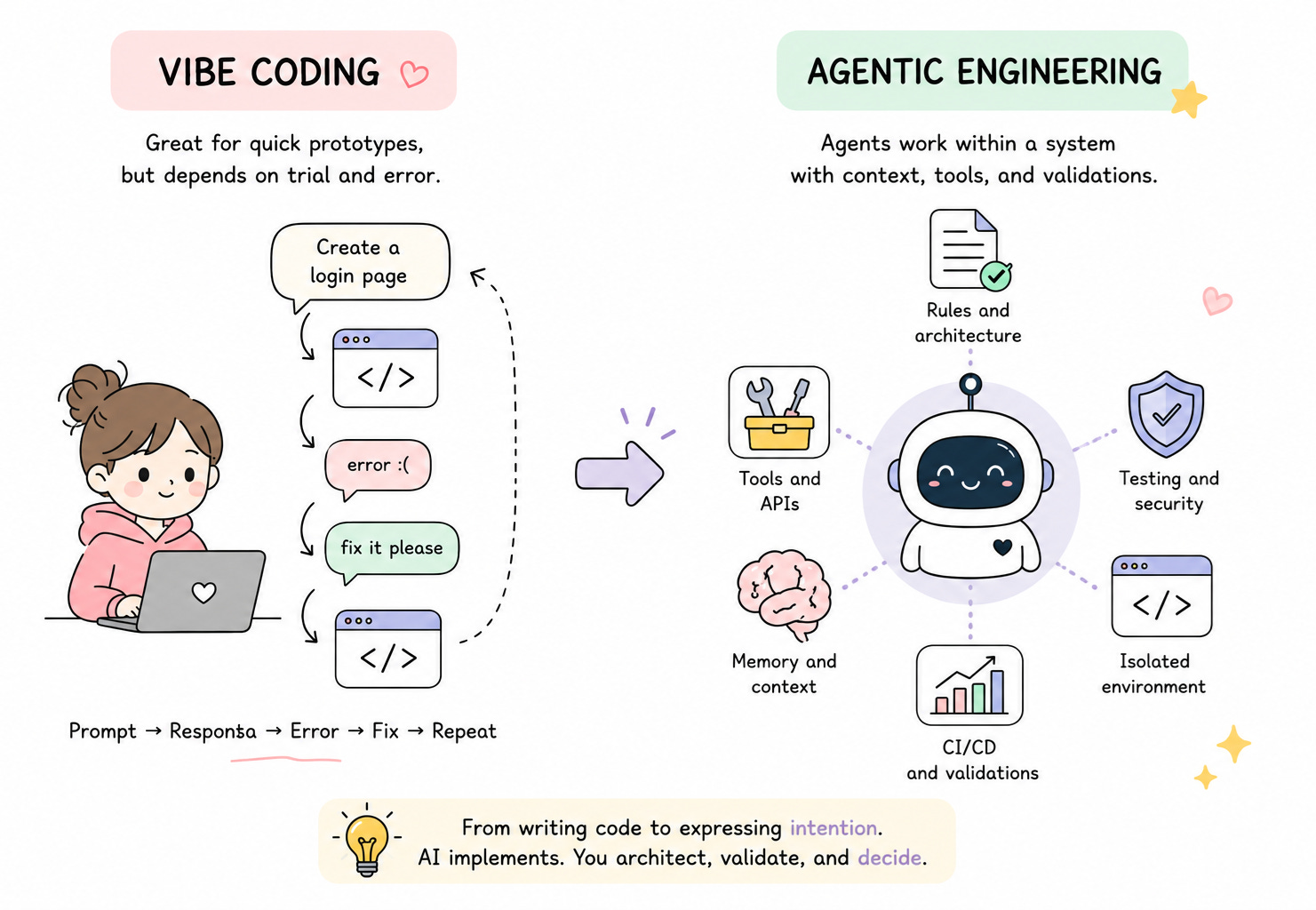
Artificial Intelligence is fundamentally changing the way we build software.
For decades, programming meant translating human problems into a language that computers could understand.
Developers needed a deep understanding of syntax, libraries, and implementation details to turn an idea into executable code.
Today, that paradigm is changing. 💡
More and more, implementation is no longer the sole responsibility of the developer—it is increasingly being carried out by AI models.
The developer’s role is shifting from writing every line of code to defining intent, designing architectures, validating results, and making critical decisions.
This may be the most significant transformation in software engineering since the emergence of high-level programming languages.
Follow our page on LinkedIn for more content like this! ❤
See also
What Are Skills in AI Agent Systems? And How to Build Your Own
I asked Gemma 4 to explain AI diagrams. The results surprised me.
Code Is No Longer the Product
Tools like Claude Code, Codex, Gemini CLI, Cursor, Windsurf, and GitHub Copilot can generate thousands of lines of code in just a few minutes.
This means that writing code is no longer the primary bottleneck in software development.
The real challenge now is ensuring that this code is correct, secure, maintainable, and aligned with the project’s goals.
In other words, the value of the developer is shifting from implementation to technical judgment.
AI writes.
Developers decide.
What Is Vibe Coding?
When developers first start using AI for programming, they often go through a phase known as Vibe Coding.
The idea is simple: you describe what you want to build in natural language, accept the code generated by the AI, and, if something goes wrong, paste the error message back into the chat, expecting the AI to fix it.
It is an extremely productive approach for:
prototypes;
personal projects;
proof-of-concept applications;
simple automations;
experimenting with new technologies.
In practice, it is possible to build a functional application in just a few hours without writing virtually any code manually.
The challenge begins when this same development style is applied to production systems.
The Limits of Vibe Coding
While extremely productive for prototypes and low-risk projects, Vibe Coding has its limitations when applied to production systems.
In this approach, developers describe what they want in natural language and, whenever something doesn’t work as expected, rely on the AI to fix the code based on the resulting error messages.
For simple projects, this workflow is often sufficient.
However, production systems require more structured approaches to validation, architecture, and automated testing.
This is where a new paradigm begins to emerge.
Agentic Engineering
Agentic Engineering is more than simply using AI agents.
It represents a fundamentally different way of building software.
In this model, AI agents operate within an environment that has been carefully designed by developers.
This includes, for example:
architectural documentation;
development guidelines;
approved tools;
isolated execution environments;
automated testing;
CI/CD pipelines;
security policies.
Instead of simply asking, “Write this code,” developers design a system in which agents operate under well-defined constraints.
The goal is no longer just to generate code.
The goal is to build a reliable process for generating code.
The New Software Development Lifecycle
Artificial Intelligence is also reshaping the traditional Software Development Life Cycle (SDLC).
Implementation, which once took days or even weeks, can now often be completed in a matter of hours.
However, other stages remain fundamentally human.
Defining requirements.
Making architectural decisions.
Assessing risks.
Understanding the business.
These activities require context, experience, and judgment—capabilities that remain the responsibility of software professionals.
As a result, modern software development is becoming less about how quickly we can write code and more about how effectively we can make sound technical decisions.
Developers Have Become Factory Managers
A useful analogy is to think of a factory.
In the past, developers were the workers assembling every component by hand.
Today, they are much closer to factory managers.
Their job is to design the production line.
They define:
the specifications;
the agents responsible for implementation;
the testing strategy;
the quality criteria;
the validation mechanisms.
The primary product is no longer the code itself.
The product is now the system capable of producing high-quality code.
The 80% Problem
There is a common pattern that many AI practitioners have observed.
The first 80% of development can be completed remarkably quickly.
The remaining 20%, however, still requires significant effort.
These final steps typically involve edge cases, error handling, and subtle integration issues that require deep contextual understanding—something AI systems often lack.
This is why, even with highly capable AI agents, human oversight remains essential.
An Agent Is Much More Than a Model
There is a common misconception that models such as GPT, Claude, or Gemini are complete AI agents on their own.
In reality, they are not.
A modern AI agent is made up of several components working together.
A useful way to summarize this is:
Agent = Model + Harness
The model provides the reasoning capabilities (the engine).
The harness provides everything that enables the model to operate effectively in the real world.
This includes:
tools (APIs);
memory;
instruction files;
isolated execution environments (sandboxes);
permission management;
safety mechanisms (guardrails).
In many cases, when an AI agent behaves unexpectedly, the problem is not the model itself but the way its surrounding environment has been designed.
Context Engineering: The New Essential Skill
For a long time, many believed that the secret to working effectively with AI was writing better prompts.
Today, we know that prompting is only a small part of the equation.
The real differentiator is Context Engineering.
Rather than simply asking better questions, developers must provide AI agents with all the information they need to perform their tasks effectively.
One of the biggest challenges is balancing static context (rules that are always loaded and consume tokens, such as an AGENTS.md file) with dynamic context, including skills and documents that are loaded on demand only when needed.
Finding this balance is essential for reducing costs, improving performance, and building scalable AI agents.
Conductor or Orchestrator?
As AI agents become more capable, the role of the developer is evolving into two primary modes.
The first is the Conductor.
In this mode, developers work side by side with an AI agent inside their IDE, continuously reviewing suggestions, making adjustments, and guiding the agent’s reasoning.
The second is the Orchestrator.
Here, multiple AI agents work autonomously in the background.
Developers define high-level objectives, monitor the generated results, and review only the final deliverables, such as pull requests or significant architectural changes.
It represents a fundamental shift in how we interact with software.
The Hidden Economics of AI
Another important aspect is the operational cost of these systems.
Vibe Coding has an extremely low barrier to entry.
Anyone can get started quickly.
However, it often leads to higher token consumption, increased rework, and greater maintenance costs over time.
Agentic Engineering, on the other hand, requires a larger upfront investment in documentation, architecture, testing, and development processes.
In return, this initial effort can significantly reduce long-term operational costs.
Conclusion
We are entering a new era of software engineering.
AI is becoming increasingly capable of solving the code generation problem.
Yet this does not diminish the importance of developers.
On the contrary.
It shifts their focus toward higher-value activities: architecture, decision-making, validation, context, and governance.
The interface of the future will not be a programming language.
It will be intent.
And the professionals who learn how to design systems, coordinate AI agents, and build reliable architectures will lead the next generation of software development.
This article was inspired by the ideas presented in The New SDLC With Vibe Coding: From Ad-hoc Prompting to Agentic Engineering, by Addy Osmani, Shubham Saboo, and Sokratis Kartakis (Google), and reflects my own interpretation and analysis of how AI is transforming modern software engineering.
I like it. It's only vibe coding when we don't have a spec sheet and rules. I can get behind this.