
Surviving the AI Era: What Every Organization Needs to Know About LLM Security
Insights from the Book "AI-Native LLM Security"

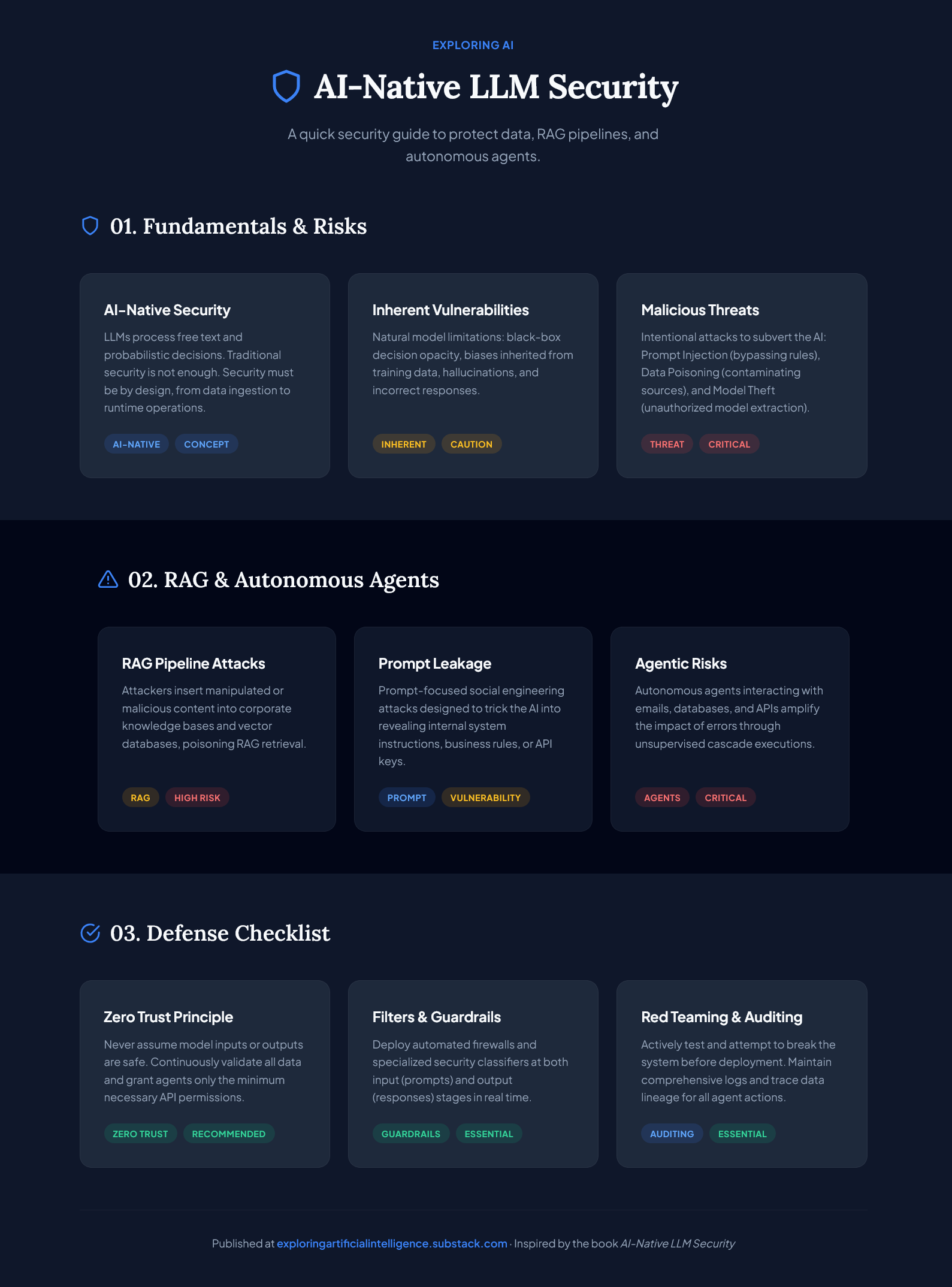
As AI and LLMs become increasingly integrated into business pipelines, RAG systems, autonomous agents, and enterprise applications, it is becoming clear that traditional security models are no longer sufficient to address the new risks introduced by these architectures.
Attacks such as prompt injection, data poisoning, model extraction, and vector database compromise demonstrate that securing AI applications requires a fundamentally different approach from the one used for conventional systems.
So the question becomes:
👉🏼 How do we protect data, processes, and businesses in an increasingly AI-driven world?
With this context in mind, I explored AI-Native LLM Security by Vaibhav Malik, Ken Huang, and Ads Dawson.
The book provides a comprehensive overview of the security challenges emerging in the era of large language models and explains why traditional security practices are no longer enough.
In this week’s article, we’ll explore the key insights.
Follow our page on LinkedIn for more content like this! ❤
Also worth reading:
A practical guide to building AI skills (don’t forget to leave a ⭐)
I asked Gemma 4 to explain AI diagrams. The results surprised me.
1. Traditional Security Was Not Designed for AI
For decades, cybersecurity focused on protecting networks, applications, and databases.
LLMs have fundamentally changed this landscape.
While conventional systems process structured commands, language models interpret free-form text, understand context, and generate probabilistic outputs.
This creates an entirely new attack surface.
For this reason, the authors advocate for an AI-Native Security approach, where security is no longer treated as an additional layer but is embedded throughout the entire development lifecycle.
The concept of Security by Design should be applied at every stage, including data collection, training, deployment, and model operations.
2. Risks Come from Two Directions
The book categorizes AI risks into two broad groups.
Inherent Vulnerabilities
These are characteristics intrinsic to the models themselves:
Decision-making opacity (the “black box” problem);
Biases inherited from training data;
Unpredictable behavior;
Hallucinations and inaccurate outputs.
Even without a malicious actor, these limitations can create financial, legal, and reputational risks.
Malicious Threats
These involve intentional attacks that are becoming increasingly sophisticated:
Prompt Injection: Manipulated instructions designed to bypass safeguards;
Data Poisoning: Corruption of data used for training or retrieval;
Model Theft: Unauthorized copying or extraction of proprietary models;
Sensitive Information Extraction: Obtaining internal information through social engineering techniques applied to AI systems.
3. The Big Shift: RAG and Autonomous Agents Have Expanded the Battlefield
If 2023 and 2024 were dominated by concerns about chatbots, the landscape changed dramatically in 2025.
Recent OWASP updates show that the most critical risks are now associated with RAG (Retrieval-Augmented Generation) systems and autonomous agents.
OWASP refers to the Open Web Application Security Project, a globally recognized authority on application security that helps developers and organizations prioritize cybersecurity efforts by identifying the most critical risks facing modern software systems.
RAG Can Be Attacked Too
When a model relies on corporate documents, knowledge bases, or vector databases to generate responses, a new attack surface emerges.
An attacker can inject manipulated content into these sources, influencing the model’s outputs.
In other words, the AI may begin providing incorrect information or taking actions based on compromised knowledge.
System Prompt Leakage
Another growing concern is the exposure of a model’s internal instructions.
Through carefully crafted attacks and social engineering techniques, adversaries may induce the AI system to reveal system prompts, business rules, credentials, or other sensitive configuration details that were never intended to be exposed.
The Risk of Autonomous Agents
Perhaps the most significant shift is the rise of agentic AI.
Today, AI agents can access emails, query databases, interact with APIs, execute workflows, and make decisions with minimal human supervision.
This autonomy dramatically increases the potential impact of failures.
A single mistake can trigger cascading actions, misuse of tools, or the execution of objectives that are misaligned with the organization’s interests.
4. The Defensive Checklist Recommended by the Authors
While the challenges are significant, the book outlines several fundamental practices for reducing risk.
Adopt a Zero-Trust Mindset
Never assume that model inputs, outputs, or behaviors are inherently safe.
Validate everything, continuously monitor system activity, and grant agents only the minimum permissions required to perform their tasks.
Filter Inputs and Outputs
Security mechanisms such as guardrails and specialized safety models can help detect attacks before they reach the LLM and prevent unsafe or inappropriate responses from reaching end users.
Conduct Regular Red Teaming Exercises
Before deploying an AI application to production, actively attempt to break it.
Simulate attacks, probe for vulnerabilities, and evaluate how the system responds to adversarial behavior. The earlier weaknesses are discovered, the lower the cost of remediation.
Ensure End-to-End Traceability
Understand the provenance of the data used by your AI systems and maintain detailed records of the actions performed by autonomous agents.
Without proper observability and auditing, investigating incidents becomes extremely difficult.
Conclusion
Generative AI is rapidly becoming the new interface layer between people and digital systems.
However, as increasingly powerful models are connected to corporate data, critical applications, and business processes, the overall attack surface continues to expand.
The book’s central message is clear: security cannot be treated as an afterthought in AI architectures. It must be embedded into their very foundation.
Organizations that recognize this shift today will be far better positioned to leverage the benefits of AI while preserving trust, privacy, and business continuity.
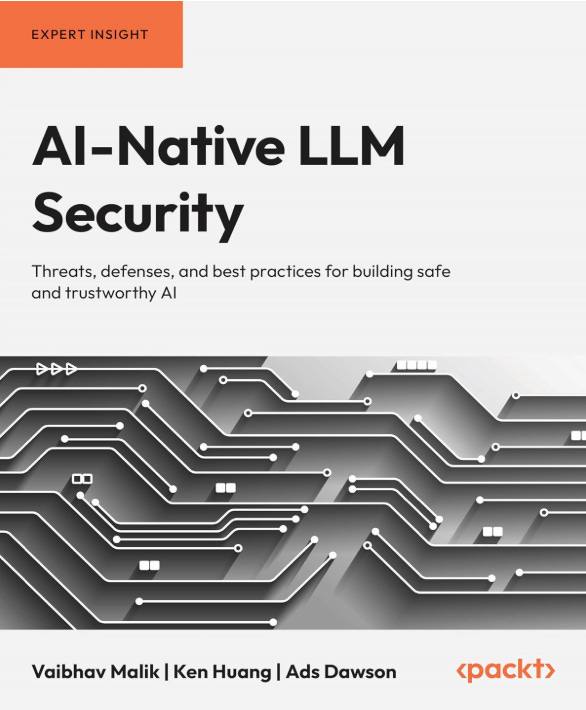
For those interested in reading the book: AI-Native LLM Security: Threats, defenses, and best practices for building safe and trustworthy AI.
If you enjoyed this article, feel free to like, share, and spread it with your colleagues 🚀