
What Every AI Engineer Should Know About Context Engineering
For years, we've talked about prompts. Now it's time to talk about context.

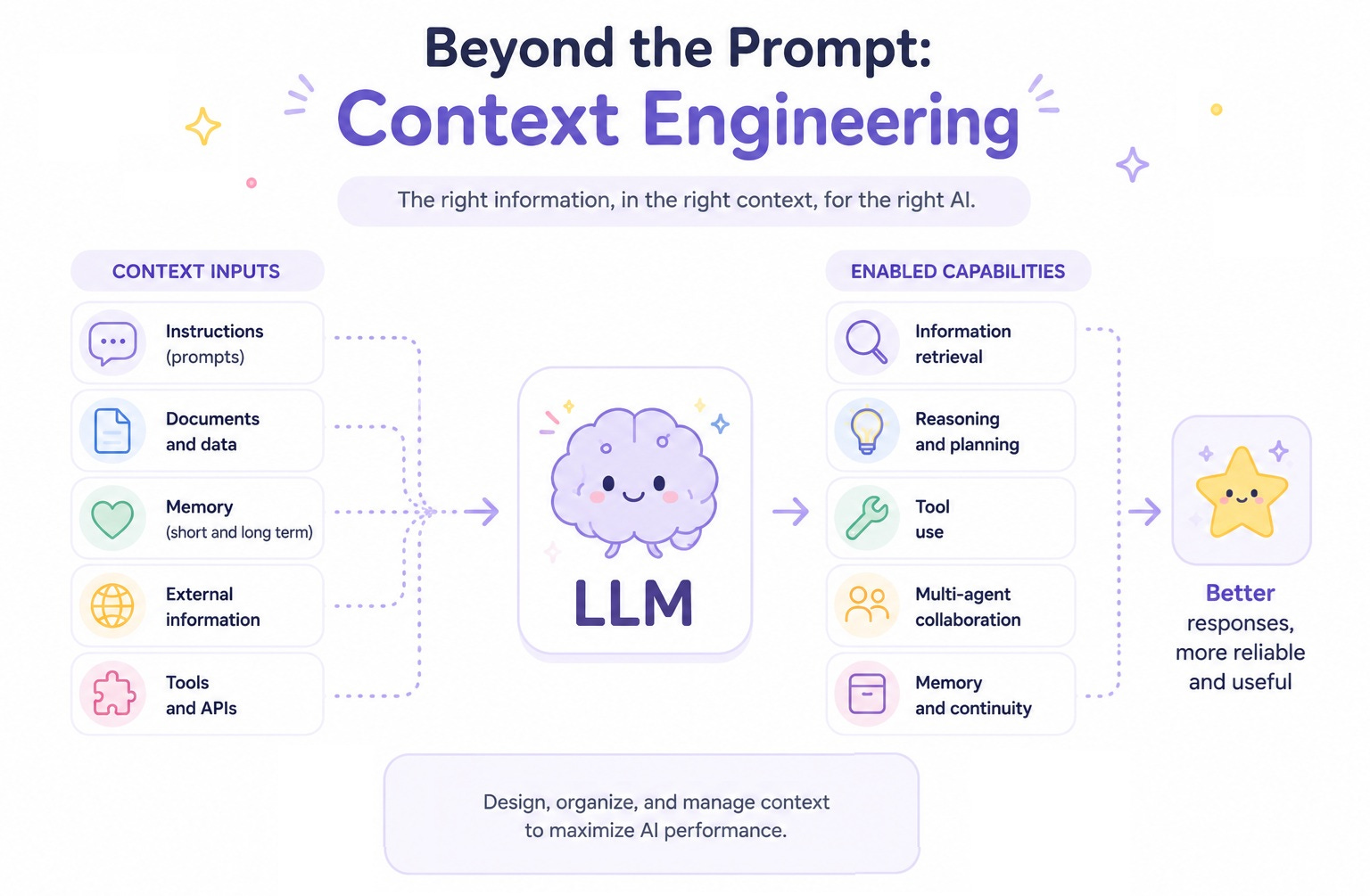
For a long time, much of the discussion around LLMs revolved around Prompt Engineering: the practice of designing increasingly effective instructions to obtain more accurate responses from language models.
As these models began tackling more complex tasks, it became clear that the quality of their outputs depends on much more than a well-crafted prompt.
Today, the determining factor is the entire set of information made available to the model during inference, including retrieved documents, memory from previous interactions, tool calls, examples, conversation history, and structured data.
This is where Context Engineering comes in—a discipline focused on designing, organizing, and managing all of this information to maximize the performance of language models.
In today’s article, we’ll explore this topic by covering its fundamental components, system implementations, evaluation methods, and open research challenges.
Follow our page on LinkedIn for more content like this! ❤
See also
What Are Skills in AI Agent Systems? And How to Build Your Own
The New Era of Software Development: From Vibe Coding to Agentic Engineering
Surviving the AI Era: What Every Organization Needs to Know About LLM Security
1. Fundamental Components
Context Engineering treats the input to an LLM as a dynamic structure composed of multiple sources of information that must be selected, organized, and processed before generating a response.
Context Retrieval and Generation
The first component is context retrieval and generation, which is responsible for obtaining or constructing the information that will be provided to the model.
This includes prompting strategies such as Chain-of-Thought and Tree-of-Thoughts, as well as retrieving external knowledge and dynamically composing the context.
Context Processing
The second component is context processing, which encompasses techniques that enable the efficient use of this information.
These include methods for handling very long sequences, iterative self-refinement mechanisms, and strategies for integrating multiple data modalities, such as text, images, audio, and structured information stored in tables or knowledge graphs.
Context Management
The third component is context management, which is responsible for organizing the system’s memory.
Since LLMs have a limited context window, techniques such as context compression, hierarchical storage, and short-term and long-term memory management are required to preserve relevant information across interactions.
2. System Implementations
The concepts of Context Engineering become truly impactful when they are incorporated into complete architectures for real-world applications.
The real power emerges when these fundamental components are combined to build integrated systems and intelligent architectures, connecting LLMs to the external world.
Retrieval-Augmented Generation (RAG)
One of the best-known examples is Retrieval-Augmented Generation (RAG), an approach that has evolved considerably in recent years.
Beyond traditional RAG, new variants have emerged, such as Agentic RAG, in which agents iteratively plan and refine the information retrieval process, and GraphRAG, which uses graphs to represent relationships between entities and documents, improving the retrieval of interconnected knowledge.
Memory Systems
Another important element is memory systems, which allow relevant information to be retained across multiple interactions.
Instead of treating every conversation as an isolated session, these mechanisms enable agents to maintain context over time, supporting tasks that require continuity and personalization.
Tool-Integrated Reasoning
Tool-Integrated Reasoning is an approach in which models use external tools during the reasoning process.
Through function calling, APIs, or code execution, LLMs move beyond relying solely on their parametric knowledge, gaining access to up-to-date information and the ability to perform actions in external environments.
Multi-Agent Systems
Finally, multi-agent systems represent another important research direction.
In these scenarios, multiple specialized agents collaborate to solve complex tasks, requiring mechanisms for coordination, communication, and task allocation.
3. The Challenge of Evaluation
As these systems become more sophisticated, evaluating them also becomes significantly more challenging.
Traditional metrics, which focus primarily on the quality of the generated text, are no longer sufficient to assess architectures that combine information retrieval, memory, external tools, and multiple agents.
Effective evaluation should be performed at different levels.
Some benchmarks assess individual components—for example, the ability to retrieve relevant information from large document collections.
Others evaluate the behavior of the system as a whole, considering aspects such as agent coordination, proper tool usage, and memory retention across extended interactions.
Beyond response quality, evaluation now also includes criteria related to robustness, safety, reliability, and bias mitigation.
As the complexity of these systems increases, traditional evaluation methods used in AI research are becoming increasingly insufficient.
4. Open Challenges
Although Context Engineering has advanced rapidly, several important challenges remain open.
One example is an asymmetry observed in current language models:
👉🏼 LLMs are remarkably good at understanding long and complex contexts. However, when asked to generate equally long outputs while maintaining the same level of sophistication and coherence, their performance consistently declines.
Other open research challenges include:
Developing stronger theoretical foundations for Context Engineering.
Reducing the computational cost of processing long contexts, particularly the limitations imposed by the Transformer attention mechanism.
Designing new architectures that scale more efficiently.
Enabling more effective collaboration between humans, agents, and external tools.
🚀 Learn AI by Building
Join our newsletter and get exclusive access to 30+ practical notebooks with step-by-step tutorials.
👉 Subscribe now and start building
Conclusion
The evolution of LLMs shows that the performance of these systems depends less and less on a single prompt and increasingly on the quality of the context provided during inference.
In this scenario, Context Engineering emerges as a discipline that integrates information retrieval, memory, tool-assisted reasoning, and multi-agent coordination into architectures capable of solving increasingly complex tasks.
More than simply an evolution of Prompt Engineering, it represents a shift in how we design applications based on language models.
→ The focus is no longer limited to the instruction given to the model; it now encompasses the entire lifecycle of constructing, organizing, and managing the information that supports the inference process.
This shift is already shaping the development of the most advanced LLM-based systems and is expected to play an increasingly important role in the next generation of AI applications.
This article was inspired by the survey “A Survey of Context Engineering for Large Language Models,” which synthesizes and organizes more than 1,400 research papers on the topic. If you’d like to dive deeper into Context Engineering, the full paper is well worth reading. 🚀